Math 571 Analytic Number
Theory I, Fall 2001
Our objective, starting only from the most elementary
considerations, is to study the behaviour of the prime numbers and, in
particular, their distribution. One of the underlying motives for the course
is an amazing and beautiful explicit formula, discovered by
Georg Friedrich Bernhard Riemann,
1826-1866,
connecting the prime numbers with the zeros of the Riemann
zeta-function. One form of this states that
S log
p = x
- S
x^r/r-z'(0)/z(0).
Here the the sum on the left is over the prime powers
p^k
not
exceeding x and the sum on the right is over the zeros r
of the Riemann z-function.
The famous Rieman Hypothesis is the
statement that the non-real zeros all have their real part equal to ½,
and this is perhaps now the most important unsolved problem in mathematics.
This has many important generalizations. For an account of this and connected
questions see the article by Enrico
Bombieri at http://www.claymath.org/prizeproblems/riemann.htm.
TOPICS
-
The theory of congruences. Primitive roots. Arithmetical
functions. Dirichlet convolution and Dirichlet series.
-
Chebychev's inequalities for the prime counting function,
and Merten's theorem.
-
Dirichlet characters, and L-functions. Dirichlet's theorem
that there are infinitely many primes in an arithmetic progression.
-
The Riemann zeta-function and its properties. Connections
with automorphic forms. The prime number theorem. Generalizations and applications.
-
The large sieve, and Bombieri's theorem on primes in arithmetic
progressions.
TEXTS
-
Multiplicative Number Theory by Harold Davenport, third edition
revised by Hugh Montgomery, Springer-Verlag, 2000.
-
Introduction to Analytic and Probabilistic Number Theory
by Gérald Tenenbaum, Cambridge University Press, 1995, ISBN 0521412617.
DETAILS
-
Fall 2001 Schedule Number: 826656
-
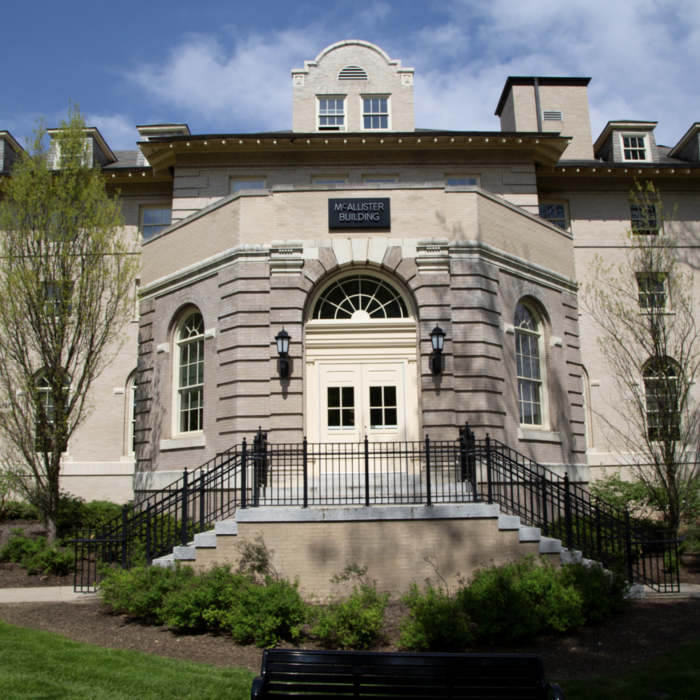
MWF 2:30-3:30 Classroom: 116 McAllister
-
Instructor Robert Vaughan, Office 211 McAllister, Tel: 865-3583,
Email: rvaughan@math.psu.edu
-
Office hours 1:25-2:15 MWF and otherwise by arrangement.
-
Grades will be based on attendance and homework.