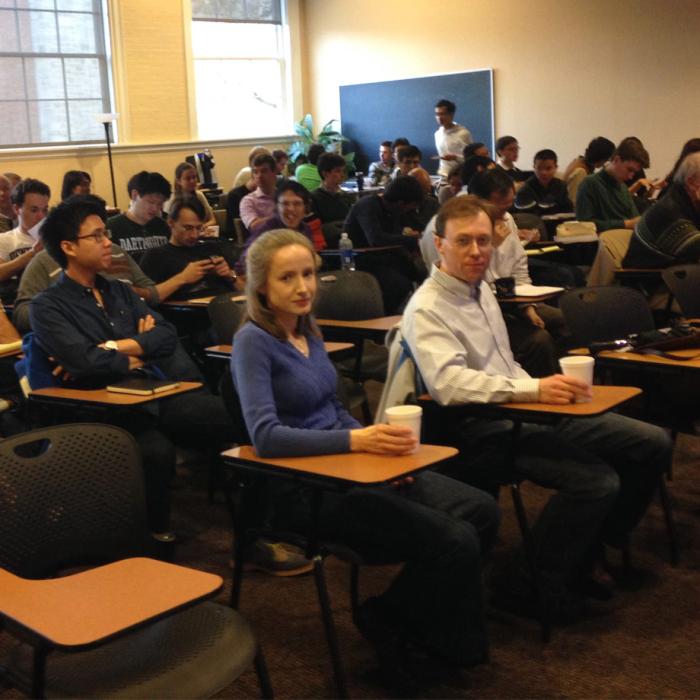
| George Andrews (PSU) | Title: | Multipartition identities and the Tri-Pentagonal Number Theorem |
Abstract: | In the Journal of Combinatorial Theory, 91(2000), 464-475, Bailey chains were extended to multiple series, and new Pentagonal Number Theorems were deduced. The triple series involving pentagonal numbers (the Tri-Pentagonal Number Theorem) was most intriguing. In this talk, we shall both interpret the related triple q-series as the generating function for certain tri-partitions, and we shall show that the triple pentagonal number side of the identity can be reduced to a linear combination of three infinite products. We shall then discuss the further possibilities of multipartition identities. |
| George Andrews (PSU) | Title: | Multipartition identities and the Tri-Pentagonal Number Theorem: Part II |
Abstract: | In the previous lecture Bailey chains were extended to multiple series, and new Pentagonal Number Theorems were deduced (cf. Journal of Combinatorial Theory, 91(2000), 464-475). The triple series involving pentagonal numbers (the Tri-Pentagonal Number Theorem) was most intriguing. In the previous talk, we showed that the triple pentagonal number side of the identity can be reduced to a linear combination of three infinite products. In this talk, we shall interpret the related triple q-series as the generating function for certain tri-partitions. We shall also discuss congruences for multipartition functions, and then discuss the further possibilities for multipartition identities. |
| Eric Mortenson (PSU) | Title: | On The Broken 1-Diamond Partition (Expanded) |
Abstract: | This will begin a two-week series expanding and detailing the ideas underlying last week's Algebra and Number Theory Seminar talk. |
| Eric Mortenson (PSU) | Title: | On The Broken k-Diamond Partition, Part 2 |
Abstract: | Dr. Mortenson will continue his series on the the broken k-diamond partition. |
| Eric Mortenson (PSU) | Title: | On The Broken k-Diamond Partition, Part 3 |
Abstract: | This talk will conclude Dr. Mortenson's series on broken k-diamon partitions. |
| James Sellers (PSU) | Title: | Parity Results for Broken k-Diamonds |
Abstract: | In one of their most recent works, George Andrews and Peter Paule continue their study of partition functions via MacMahon's Partition Analysis by considering partition functions associated with directed graphs consisting of chains of hexagons. In this talk, we will focus on parity results for these "broken k-diamonds" and prove a conjectured congruence which Andrews and Paule noted in their work. In the process, we also prove a number of other congruences modulo 2 (and, for free, we provide another proof of the modulo 3 congruence that they highlight in their paper). We will close the talk by sharing a number of conjectures modulo 2 for various k. All of our results follow from straightforward generating function manipulations. |
| Jocelyn Quaintance (Temple) | Title: | Word Representations of m x n x p Proper Arrays |
Abstract: | Let m != n. An m x n x p proper array is a three-dimensional array composed of directed cubes that obeys certain constraints. Because of these constraints, the m x n x p proper arrays may be classified via a schema in which each m x n x p proper array is associated with a particular m x n planar face. By representing each connencted component present in the m x n planar face with a distinct letter, and the position of each outward pointing connector by a circle, an m x n array of circled letters is formed. This m x n array of circled letters is the word representation associated with the m x n x p proper array. The main result involves the enumeration of all m x n word representations modulo symmetry, where the symmetry is derived from the group D_2 = C_2 x C_2 acting on the set of word representations. This enumeration is achieved by forming a linear combination of four exponential generating functions, each of which is derived from a particular symmetry operation. This linear combination counts the number of partitions of the set of m x n word representations that are inequivalent under D_2. |
| Ae Ja Yee (PSU) | Title: | Integer analogs of lecture hall theorems and the combinatorics of l-sequences. |
Abstract: | This is a preliminary report of joint work with Carla Savage and Nick Loehr. In this talk we will discuss quantum integer interpretations of various lecture hall theorems and the l-nomial coefficient. |
| November 21 | The University follows a Friday schedule on this date and thus alters regular attendees' schedules, so there will not be a Combinatorics/Partitions Seminar this day. |
| James Sellers (PSU) | Title: | Tiling Proofs of Recent Sum Identities Involving Pell Numbers |
Abstract: | In a recent note, Santana and Diaz-Barrero proved a number of sum identities involving the well-known Pell numbers. Their proofs relied heavily on the Binet formula for the Pell numbers. In this talk, I will discuss new proofs derived in joint work with Art Benjamin and Sean Plott by reconsidering these identities from a purely combinatorial viewpoint. We provide bijective proofs for each of the results by interpreting the Pell numbers as enumerators of certain types of tilings. In turn, our proofs provide helpful insight for straightforward generalizations of a number of the identities. Time permitting, I will mention more recent work on q-analogues of some of these Pell sum identities obtained in joint work with Karen Briggs, and may briefly attempt to relate some of this work to the partitions-related work of Jose Plinio-Santos and Drew Sills in connection with q-Pell numbers. |