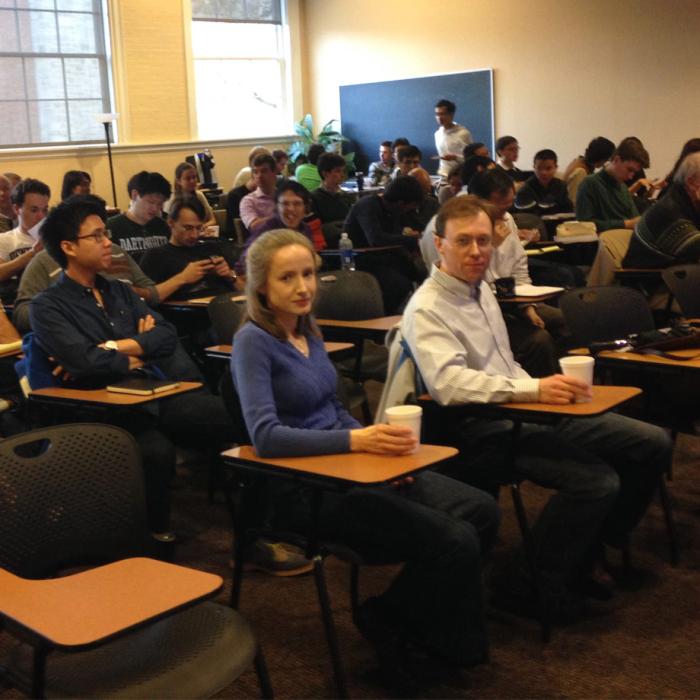
| Kirsten Eisentrager (Michigan) | Title: | Hilbert's Tenth Problem for algebraic function fields |
Abstract: | Hilbert's Tenth Problem in its original form was to find an algorithm to decide, given a polynomial equation $f(x_1,\dots,x_n)=0$ with integer coefficients, whether it has a solution with $x_1, \dots, x_n \in \mathbf{Z}$. Matiyasevich proved that no such algorithm exists, i.e. Hilbert's Tenth Problem is undecidable. Since then, analogues of this problem have been studied by asking the same question for polynomial equations with coefficients and solutions in other commutative rings. In this talk we will discuss how elliptic curves of rank one can be used to prove undecidability of Hilbert's Tenth Problem for algebraic function fields, such as function fields over $p$-adic fields and function fields of varieties over $\mathbf{C}$ of dimension at least two. |
| Christopher Francisco (Missouri) | Title: | Commutative algebra, graphs, and Alexander duality |
Abstract: | The field of combinatorial commutative algebra offers ways to use combinatorics to understand properties of ideals and algebra to classify combinatorial objects. We will discuss some recent projects that focus on the connections between graphs and monomial ideals in polynomial rings, using the notions of Stanley-Reisner theory, facet ideals, and Alexander duality as bridges. In particular, we will explore relations between linear resolutions and the Cohen-Macaulay property on the algebraic side and induced cycles of a graph on the combinatorial side. Much of the talk is based on joint work with Huy Tai Ha and Adam Van Tuyl. |
| Mihran Papikian (Stanford) | Title: | Drinfeld modular varieties as varieties with many rational points over finite fields |
Abstract: | We show that appropriate quotients of Drinfeld modular varieties and the modular varieties of D-elliptic sheaves have many rational points over certain finite fields compared to their Betti numbers. This is a generalization to higher dimensions of some well-known results for modular curves. |
| Title: | Abstract: |
| Title: | Abstract: |
| Trevor Wooley (Michigan) | Title: | Waring's problem over function fields |
Abstract: | We discuss recent work joint with Yu-Ru Liu in which the circle method is applied in the polynomial ring k[t], where k is the finite field on q elements. In contrast to most applications of the circle method in this context, our methods are effective when the characteristic of k is smaller than the degree of the ambient problem, as well as in circumstances wherein the characteristic is larger than this degree. |
| Title: | Abstract: |
| Title: | Abstract: |
| March 13 | Spring Break |
| Title: | Abstract: |
| Title: | Abstract: |
| Brandt Kronholm (SUNY-Albany) | Title: | Congruences for Partitions into Exactly m Parts |
Abstract: | In the late 19th century, Sylvester and Cayley investigated the properties of the partition function p(n,m) which enumerates the partitions of a non-negative integer n into exactly m parts. The speaker extends techniques developed in a previous publication to investigate the congruence properties of consecutive values of this function. |
| Title: | Abstract: |
| Title: | Abstract: |
| Title: | Abstract: |
| Heiko Todt (PSU) | Title: | Some Monotonicity Theorems |
Abstract: | Consider a set P of positive integers. Let p(n) be the number of partitions of n with parts in P. We call P monotone if the sequence p(n) is weakly increasing. In a 1994 paper Friedman, Joichi and Stanton made a conjecture, which they used to give a complete characterization of all monotone sets whose minimal element is not equal 2, 3 or 5. The conjecture was eventually proven by Prellberg and Stanton in 2003. I will give an overview of the monotonicity theorems and a proof of the conjecture. |