For more information about this meeting, contact Yuxi Zheng, Kris Jenssen, Xiantao Li.
| Title: | Effective Viscosity of Bacterial Suspensions |
| Seminar: | CCMA Luncheon Seminar |
| Speaker: | Brian Haines, Penn State University |
| Abstract: |
| We present a PDE model for dilute suspensions of bacteria in a
three-dimensional Stokesian fluid. This model is used to calculate the
statistically-stationary bulk deviatoric stress and
effective viscosity of the suspension from the microscopic disturbance
flow and the details of the interaction of an elongated body with a
prescribed generic background flow. A bacterium is modeled as a
prolate spheroid with self-propulsion provided by a point force, which
appears in the model as an inhomogeneous delta function in the PDE.
The bacterium is also subject to a stochastic torque in order to model
tumbling (random reorientation). Due to a bacterium's asymmetric
shape, interactions with the background flow cause the bacterium to
preferentially align in certain directions. Due to the noise provided
by the stochastic torque, the steady-state distribution of
orientations is unique for a given background flow. Under this
distribution of orientations, self-propulsion produces a reduction in
the effective viscosity. For sufficiently weak background flows, the
effect of self-propulsion on the effective viscosity dominates all
other contributions, leading to an effective viscosity of the
suspension that is lower than the viscosity of the ambient fluid. This
is in agreement with recent experiments on suspensions of Bacillus
subtilis. We also present recent numerical work that helps to
elucidate the role played by hydrodynamic interactions between
bacteria in the reduction of the effective viscosity. |
Room Reservation Information
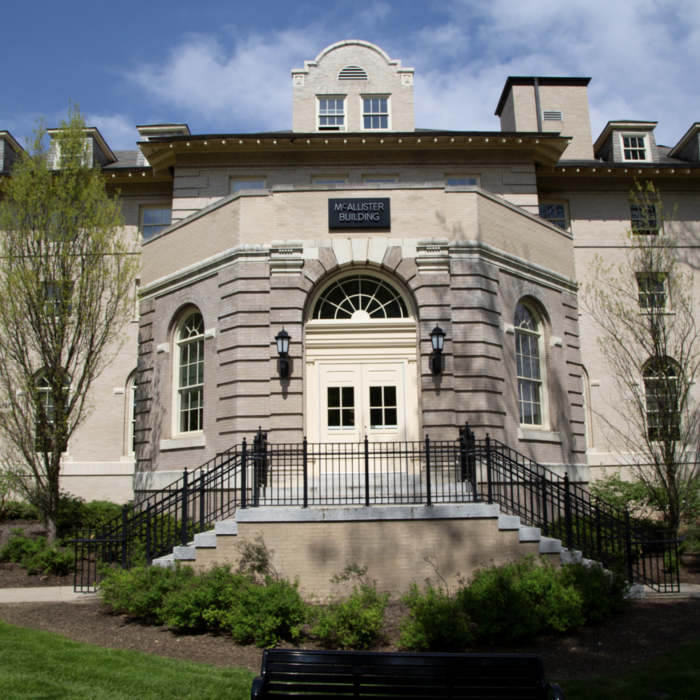
| Room Number: | MB114 |
| Date: | 11 / 12 / 2010 |
| Time: | 12:15pm - 01:30pm |