For more information about this meeting, contact Kris Jenssen, Yuxi Zheng.
| Title: | An overview of spacetime discontinuous Galerkin methods |
| Seminar: | Computational and Applied Mathematics Colloquium |
| Speaker: | Scott Miller, Applied Research Laboratory, Penn State |
| Abstract: |
| Discontinuous Galerkin methods are a family of finite element methods that utilize non-conforming solution spaces; that is, continuity is not enforced a priori through the choice of finite dimensional solution space. Instead, the governing equations and initial/boundary conditions are weakly enforced on an element-by-element basis. Spacetime discontinuous Galerkin (SDG) methods directly discretize space and time as a single entity, removing the need for separate temporal integration schemes. SDG methods possess many attractive features, including: high order convergence rates, fixed compact stencil for arbitrary interpolation order, support for fully unstructured and non-conforming meshes, and excellent stability and element-wise conservation properties. For strictly hyperbolic problems, a special mesh generation procedure may be used to solve small patches of elements independently from the remainder of the domain, resulting in a solution procedure with linear computational complexity. SDG methods are a natural choice for transient simulations of dynamic, non-smooth, and complex physics. In this work, we apply the SDG method to several different physical systems: linear elastodynamics, inviscid gas dynamics, hyperbolic heat conduction, and atomistic-to-continuum coupling. These examples will demonstrate the robustness of SDG for multi-scale and multi-physics applications, including fully non-linear models and sharp interfaces. |
Room Reservation Information
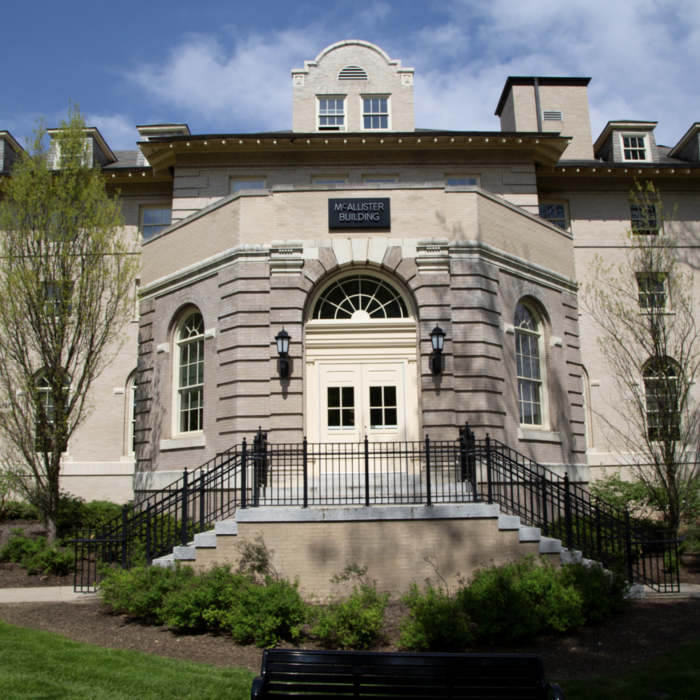
| Room Number: | MB106 |
| Date: | 11 / 06 / 2009 |
| Time: | 03:35pm - 04:25pm |